
Collaborative AI Governance: 7 Proven Layers for Business Success
“If everyone is moving forward together, then success takes care of itself.”
— Henry Ford
Collaborative AI governance changes everything about how organizations approach AI deployment.
Your CIO just presented a comprehensive AI governance framework. It’s thorough, detailed, addresses every compliance requirement.
And absolutely nobody outside IT is excited to follow it.
Why? Because it was built in a vacuum. IT created governance for the business without creating it with the business. Now you’ve got a policy document nobody wants to use.
Welcome to the fundamental problem with traditional AI governance: it’s designed as control, not collaboration.
According to Deloitte’s 2024 AI Governance survey, 70% of organizations have AI policies. Yet only 16% are satisfied with their adoption pace. Policy without buy-in is just expensive documentation.
Here’s what happens with command-and-control AI governance:
- IT writes the rules → Business finds workarounds
- Legal focuses on risk → Innovation stops
- Security locks everything down → Shadow AI proliferates
You end up with comprehensive governance nobody follows.
Enter Collaborative AI Governance
Collaborative governance flips the model. Instead of one function dictating rules, you build shared ownership across stakeholders. This applies Business Relationship principles to AI governance:
- Shared accountability across functions
- Value co-creation (governance enables outcomes, not just manages risk)
- Strategic partnerships (functions work together, not around each other)
Traditional governance asks “How do we control AI?” Collaborative governance asks “How do we enable AI success together?”
The Seven Layers of Collaborative AI Governance
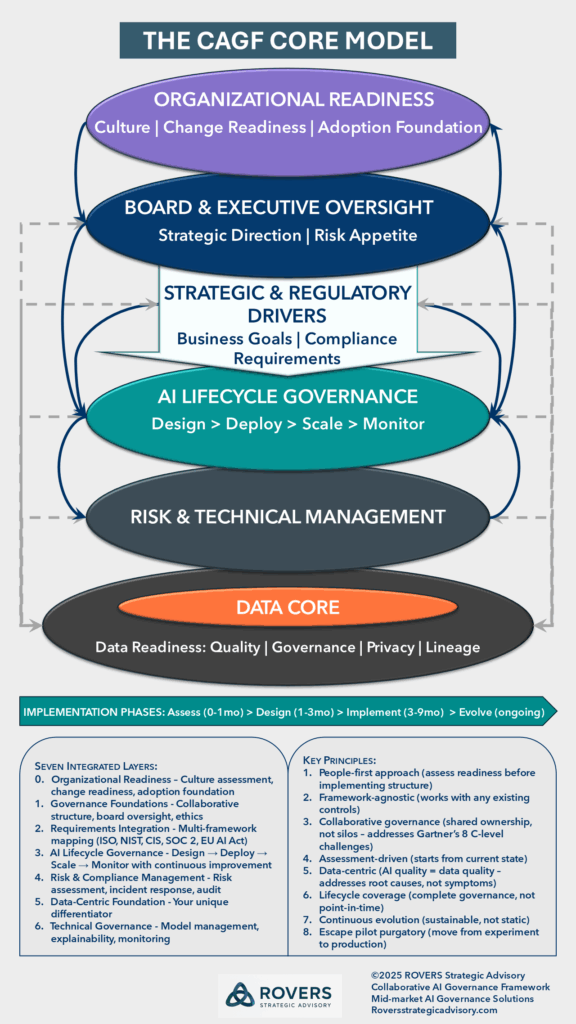
Let me introduce you to the Collaborative AI Governance Framework (CAGF)—a model that treats governance as an enabler rather than a gatekeeper.
The framework consists of seven integrated layers, starting with organizational readiness at the top. Each layer requires collaboration across different stakeholders:
Layer 0: Organizational Readiness & Culture Foundation (The Enabling Layer)
Who’s involved: CEO, HR, Change Management, All Leadership
What it addresses: Culture assessment, change readiness, adoption barriers, leadership alignment
Collaboration focus: Building belief in AI value before building governance structure
Why start here? Because 80% of AI governance failures trace back to organizational resistance, not technical problems. If your culture isn’t ready, your governance framework will collect dust.
Layer 1: Data Foundation (The Base)
Who’s involved: CDO/Data Team, IT, Legal, Business Data Owners
What it addresses: Data quality, lineage, architecture, privacy, protection
Collaboration focus: Business defines requirements; Data/IT enable infrastructure; Legal ensures compliance
Real example: A retail company discovered 14 different customer segmentation models using different definitions of “active customer.” Their collaborative data governance unified definitions. Result: AI accuracy improved 34% overnight.
Why is data at the base? Because every AI failure traces back to data problems. You can’t build reliable AI on unreliable data.
Layer 2: Technical Governance
Who’s involved: IT, Data Science, Security, Architecture
What it addresses: Model management, explainability, monitoring, drift detection
Collaboration focus: Technical teams establish standards; Business defines explainability needs
This layer manages AI technology itself—ensuring models stay current, trustworthy, and explainable.
Layer 3: Risk & Compliance Management
Who’s involved: Legal, Compliance, Security, Business Risk Owners
What it addresses: Risk assessment, ethical guidelines, human impact, regulatory compliance
Collaboration focus: Legal sets guardrails; Business defines acceptable risk; Security enables safe deployment
When Legal operates alone, innovation stops. When risk discussions happen with business stakeholders, you get risk-aware innovation.
Layer 4: AI Lifecycle Governance
Who’s involved: IT, Data Science, Business Operations, Product Teams
What it addresses: Design → Deploy → Monitor processes, production readiness gates
Collaboration focus: Technical teams enable; Business teams validate; Operations sustain
This is where AI pilots often die. Without collaborative lifecycle governance, technically sound models never reach production.
Layer 5: Requirements Integration
Who’s involved: Compliance, IT, Legal, Risk Management
What it addresses: Multi-framework mapping (ISO, NIST, CIS, SOC 2), unified compliance
Collaboration focus: Map existing frameworks to AI requirements; eliminate redundant controls
Mid-market organizations often juggle multiple compliance frameworks. This layer integrates them instead of creating new silos.
Layer 6: Governance Foundations (The Strategic Top)
Who’s involved: CEO, Board, Executive Leadership, Ethics Committee
What it addresses: Strategic alignment, board oversight, ethics, decision rights
Collaboration focus: Executive team sets direction; Board provides oversight; Ethics guide principles
This is strategic governance—ensuring AI initiatives connect to business objectives and operate within ethical boundaries.
Why This Works for Mid-Market Organizations
Large enterprises can afford separate AI Governance Offices and dedicated policy teams. Mid-market organizations need governance that’s lightweight but effective. Collaborative AI governance achieves this by leveraging existing relationships instead of creating new bureaucracy.
Collaborative governance works because it:
- Leverages existing relationships instead of creating bureaucracy
- Distributes accountability instead of centralizing bottlenecks
- Enables speed by clarifying decisions instead of adding approval layers
According to MIT CISR research, organizations with collaborative governance deploy AI 3x faster than centralized control models.
What Collaborative Governance Looks Like in Practice
A mid-sized financial services firm wanted to deploy credit risk AI. Under their old governance model, sequential handoffs between IT, Legal, Data, and Risk took 14 months.
Under collaborative governance, they formed a cross-functional AI pod where stakeholders co-created solutions together. Timeline: 6 weeks to production.
Same organization. Same requirements. Different governance approach.
The Monday Morning Question
Don’t ask: “Do we have AI governance policies documented?”
Ask instead: “Who collaborated to create our AI governance framework, and do they have shared ownership for making it work?”
If IT wrote it alone, you have documentation—not governance.
If Legal dictated it, you have risk avoidance—not enablement.
If it was created with the stakeholders who have to live with it, you have collaborative AI governance that actually works.
Making the Shift
You don’t need to rebuild everything overnight. Start with one AI initiative:
- Form a cross-functional pod (not a steering committee)
- Define shared success metrics (business value + risk + technical performance)
- Establish clear decision rights using “Informed vs. Accountable” model
- Measure governance by outcomes (speed to deployment, business value delivered)
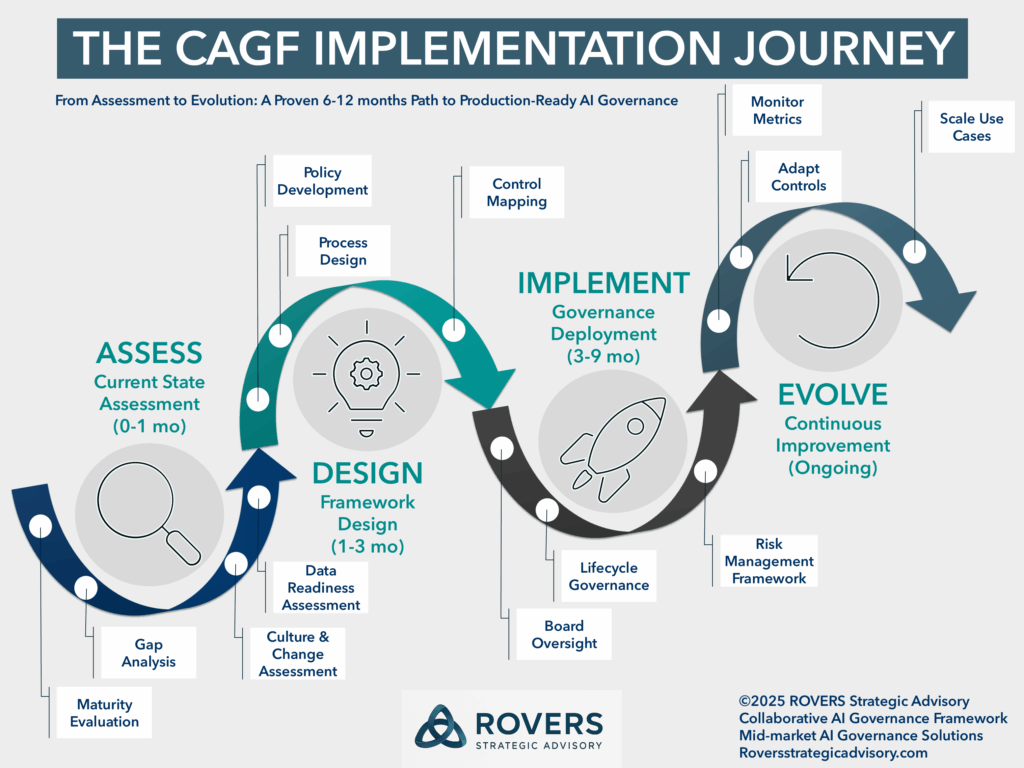
The shift from command-and-control to collaborative governance isn’t about being less rigorous. It’s about being more effective.
“None of us is as smart as all of us.”
— Ken Blanchard